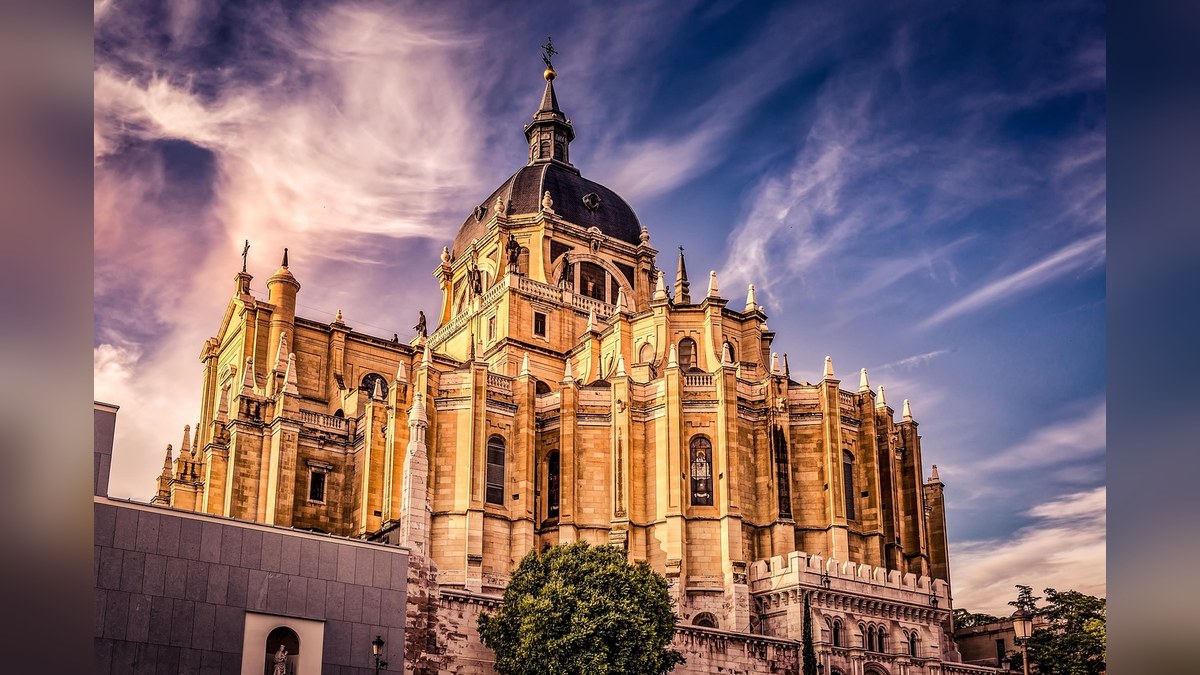
cathedral, almudena, nature, madrid, spain, architecture, landmark, europe, church, building, royal, city, european, catholic, spanish, palace, exterior, famous, monument, facade, sky, cityscape — Photo: Photo by ddzphoto on Pixabay
Madrid sets tourism record as visitor spending tops €10 billion in six months
Madrid has crossed a new tourism threshold, with international visitors spending more than €10 billion in the Spanish capital during the first half of 2026.
Foreign tourist expenditure reached €10.007 billion between January and June, an increase of 11.4% from the same period in 2025, according to eturbonews.com. Madrid welcomed 5.66 million travelers during the six months, while overnight stays rose by 3% to almost 12 million. International travelers accounted for 59% of visitors and two-thirds of all overnight stays.
The figures suggest that Madrid is not simply attracting more people. It is becoming increasingly successful at attracting visitors who spend more on hotels, restaurants, shopping, entertainment, culture and professional events.
That distinction matters. For cities facing pressure on housing, transport and public spaces, the future of tourism is increasingly being measured not just by arrivals, but by the economic value generated by each visit.
Madrid’s results place the city at the center of Spain’s continued tourism boom. International tourists spent €63.84 billion across Spain during the first half of 2026, 7% more than a year earlier. The Madrid region accounted for 15.7% of the national total, behind only the Canary Islands and Catalonia.
A natural capital of global tourism
Madrid’s rise has been reinforced by a concentration of institutions that few other destinations can match.
The city has hosted the headquarters of UN Tourism, formerly known as the World Tourism Organization, since the organization’s creation in 1975. Last month, this UN agency opened its new headquarters beside the Palacio de Congresos on the Paseo de la Castellana.
Madrid has also been selected as the new global headquarters of the World Travel & Tourism Council, the organization representing more than 200 major private-sector tourism companies.
WTTC chose Madrid following a competition that included proposals associated with France, Italy, Switzerland and Dubai. The organization cited the city’s international air connections, competitive operating environment, access to multilingual talent, government support and proximity to UN Tourism.
Bringing the leading intergovernmental tourism institution and the sector’s principal private-industry body into the same city creates the foundations of what Spanish officials describe as a ‘global tourism campus’.
The intention is to encourage cooperation on data, investment, sustainability, training and policymaking. In practical terms, Madrid is becoming not only a place where tourism happens, but also a place where the rules, investment priorities and future direction of global tourism are discussed.
The city already hosts FITUR, one of the world’s largest annual tourism trade fairs, at the IFEMA Madrid exhibition complex. Its combination of government institutions, corporate headquarters, conference facilities and direct connections with Europe and Latin America gives it an unusually strong position in the meetings, incentives, conferences and exhibitions market.
Business and conference travelers are especially valuable because their spending frequently extends beyond accommodation to venues, catering, transport, technical production and professional services. Major events can also fill hotels during periods when conventional leisure demand is lower, helping Madrid reduce the seasonality experienced by many Mediterranean destinations.
Culture, football and the Spanish way of life
Madrid’s appeal cannot be explained by institutional influence alone.
The city has assembled a broad tourism proposition around art, food, nightlife, sport, luxury retail, musical theatre and neighborhood life. The Prado, Reina Sofía and Thyssen-Bornemisza museums form one of the world’s strongest concentrations of European art, while the surrounding Paseo del Prado and Buen Retiro landscape is recognized by UNESCO.
Football provides another international gateway. Real Madrid and Atlético de Madrid attract supporters from across the world, while the redeveloped Santiago Bernabéu is being positioned as a year-round entertainment venue rather than a stadium used only on match days.
The city’s restaurant culture has also evolved from a largely domestic attraction into an international tourism product. Traditional taverns, neighborhood markets and late-night dining now sit alongside Michelin-starred restaurants, Latin American cuisine and a growing luxury-hospitality sector.
Yet Madrid’s most important tourism asset may be something less easily packaged: the ability to offer the attractions of a major global capital without completely separating visitors from everyday urban life.
Terraces remain filled late into the evening. Museums, shops and restaurants operate within neighborhoods that continue to be used by residents. Visitors encounter the Spanish rhythm of long lunches, late dinners and active public spaces rather than moving exclusively through purpose-built tourism districts.
That lifestyle helps Madrid compete against cities with more immediately recognizable monuments. Paris has the Eiffel Tower, Rome the Colosseum and London its royal and historic landmarks. Madrid’s attraction is more cumulative: art in the morning, business meetings in the afternoon, dinner after 10 p.m. and streets that remain animated well beyond midnight.
Tourism becomes a wider economic engine
The benefits are spreading through accommodation, hospitality, retail, transport and cultural industries.
Madrid ended the first half of 2026 with 920 accommodation establishments, 9.6% more than a year earlier. The sector offered more than 96,000 beds and directly employed 15,249 workers, an annual increase of 5.4%.
The United States remained Madrid’s largest international source market, producing more than 567,000 visitors in the six-month period. Italy and the United Kingdom followed, while Brazil recorded the fastest growth, with arrivals increasing by 30%.
This geographic mix is strategically important. Strong connections with the Americas allow Madrid to operate as a bridge between Europe and the Spanish- and Portuguese-speaking world. Long-haul visitors also tend to stay longer and spend more than short-break travelers arriving from neighboring countries.
Madrid’s tourism economy is consequently linked to aviation, international investment and the city’s broader emergence as a base for multinational companies. Improved air connectivity makes the city more attractive for tourists, but also for conferences, corporate offices and skilled workers. Each part of that ecosystem strengthens the others.
The city’s 2024 performance had already set records, with more than 11.2 million visitors and €16.14 billion in international spending. Madrid was subsequently ranked as the world’s second-most-attractive urban destination in the city’s cited Euromonitor assessment, behind Paris and ahead of Tokyo.
How Madrid compares globally
By raw visitor volume, Madrid remains smaller than tourism giants such as Paris and London. It also receives less concentrated sightseeing traffic than Rome and faces a different type of demand from entertainment-led destinations such as Dubai, Las Vegas or Orlando.
Its competitive strength lies instead in balance.
Unlike cities heavily dependent on one landmark, one season or one source market, Madrid combines leisure, culture, sport, gastronomy, shopping, conferences and government-related travel. Unlike many coastal destinations, it can attract visitors throughout the year. Unlike smaller heritage cities, it has sufficient transport, hotel and event infrastructure to absorb major international gatherings.
Madrid also remains less visibly overwhelmed than European destinations such as Venice, Dubrovnik and central Barcelona, where the ratio of tourists to residents and the concentration of visitors in small historic districts have produced intense political opposition.
Nevertheless, comparisons based only on citywide averages can be misleading. Madrid’s tourism pressure